Indian Railways Must Reach a New Level to Realise Viksit Bharat, Viksit Railways by 2047: Ashwini Vaishnaw
Ashwini Vaishnaw Confers 70th Ati Vishisht Rail Seva Puraskar 2025 to 100 Railway Officials, 26 Shields to Best-Performing Zones in Different Categories

Indian Railways Must Rise to a New Level to Achieve Viksit Bharat, Viksit Railways by 2047: Ashwini Vaishnaw

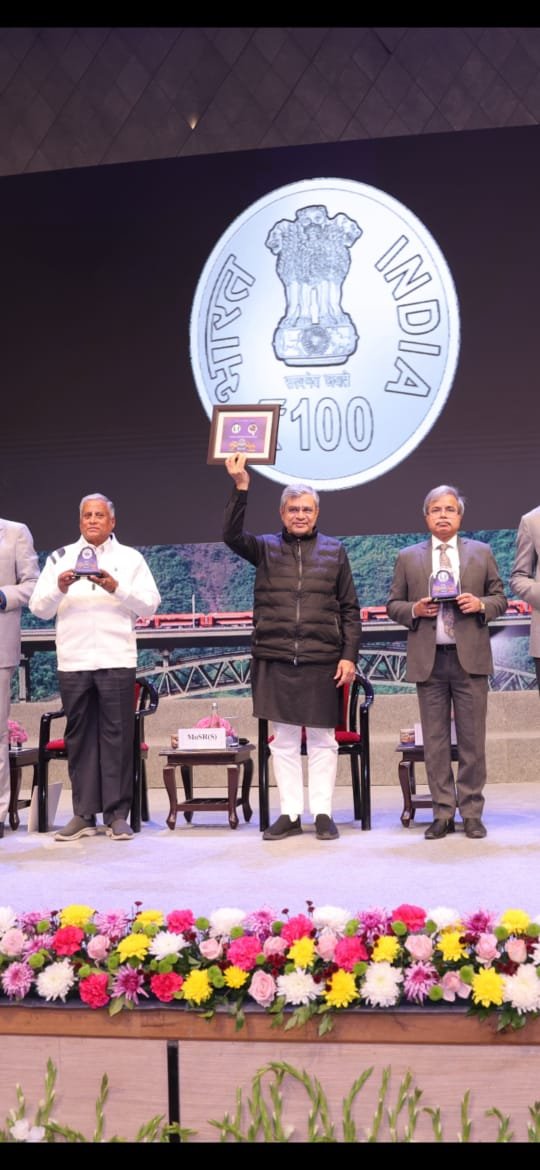
Union Minister for Railways, Information & Broadcasting, and Electronics & Information Technology, Shri Ashwini Vaishnaw, said that Indian Railways must move to an entirely new level to realise the vision of Viksit Bharat and Viksit Railways by 2047. He was speaking at the 70th Ati Vishisht Rail Seva Puraskar 2025 ceremony held at the India International Convention and Expo Centre, Yashobhoomi, Dwarka, New Delhi. On this occasion, Shri Vaishnaw conferred the prestigious Ati Vishisht Rail Seva Puraskar on 100 Railway officials and awarded 26 Shields to the best-performing Railway Zones across different categories.
The ceremony was attended by the Minister of State for Railways and Jal Shakti, Shri V. Somanna, Chairman and CEO of the Railway Board Shri Satish Kumar, Members of the Railway Board, and General Managers of various Railway Zones and Production Units. Marking a historic milestone, a commemorative coin celebrating 100 years of electrification in Indian Railways was also unveiled during the event.
Addressing the gathering, Shri Ashwini Vaishnaw congratulated the award-winning railway personnel for their dedication and exceptional service. He said that the collective efforts of railway employees over the past decade have enabled Indian Railways to overcome long-standing challenges, expand capacity, improve efficiency, and achieve major infrastructure and operational milestones. He highlighted that extensive track construction has significantly enhanced capacity, while special trains operated during peak seasons such as Diwali–Chhath, Christmas, and summer ensured smoother and more comfortable travel for passengers, setting new benchmarks in passenger management.
The Union Minister outlined an ambitious reform roadmap for 2026 titled “52 Weeks, 52 Reforms,” under which one major institutional reform will be implemented every week. These reforms will cover key functional areas including customer service, maintenance, production, quality management, health systems, and operations. He said structured workshops are being conducted across departments to redefine standards, identify bottlenecks, and establish clear, time-bound action plans with strong accountability.
Shri Vaishnaw also laid out six core resolutions that will guide Indian Railways in the coming years. These include a decisive push for systemic reforms, widespread adoption of technology, innovation and artificial intelligence, significant upgradation of maintenance standards, an uncompromising focus on safety to drastically reduce accidents, transformation of training and talent development through modern tools and mandatory skill upgradation, and the complete eradication of the colonial mindset. He urged officials to embrace new ideas, empower young officers and field staff, promote Indian solutions, and take pride in Made-in-India achievements that are gaining global recognition.
Emphasising the importance of innovation, the Minister encouraged active engagement with startups and innovators and called upon railway employees to contribute reform ideas that can be scaled across the network. Drawing parallels with major national reforms, he said Indian Railways must demonstrate similar courage and confidence in embracing change. With a young workforce, transparent systems, and a reform-oriented approach, he said Indian Railways is well positioned to emerge as a global benchmark and a key pillar of India’s journey towards becoming a developed nation by 2047.
Minister of State Shri V. Somanna, while addressing the gathering, congratulated railway employees and described Indian Railways as one of the world’s largest service organisations. He credited the Rail Parivar for ensuring safe, reliable, and comfortable travel for millions of passengers every day. He highlighted the expansion of rail connectivity to regions such as Jammu & Kashmir and the North East, calling these engineering achievements vital for strengthening national integration. Referring to Amrit Bharat and Namo Bharat trains, and the upcoming Vande Bharat Sleeper, he said these initiatives will significantly enhance long-distance and regional connectivity.
Chairman and CEO of the Railway Board Shri Satish Kumar said that Indian Railways has undergone a rapid transformation into a modern, safe, and passenger-centric organisation. He reiterated that safety remains the highest priority, supported by modern signalling systems, electronic interlocking, elimination of unmanned level crossings, enhanced track monitoring, and continuous technological upgrades. On freight operations, he said Indian Railways is setting new benchmarks through multimodal and door-to-door logistics solutions, making a meaningful contribution to the nation’s economic growth.
The Ati Vishisht Rail Seva Puraskar is conferred every year to recognise the dedication, discipline, and exceptional contributions of railway employees. The awards, presented in individual categories and as Shields to top-performing Railway Zones, celebrate excellence and reaffirm the commitment of Indian Railways to become a more efficient, safe, and passenger-friendly organisation.